
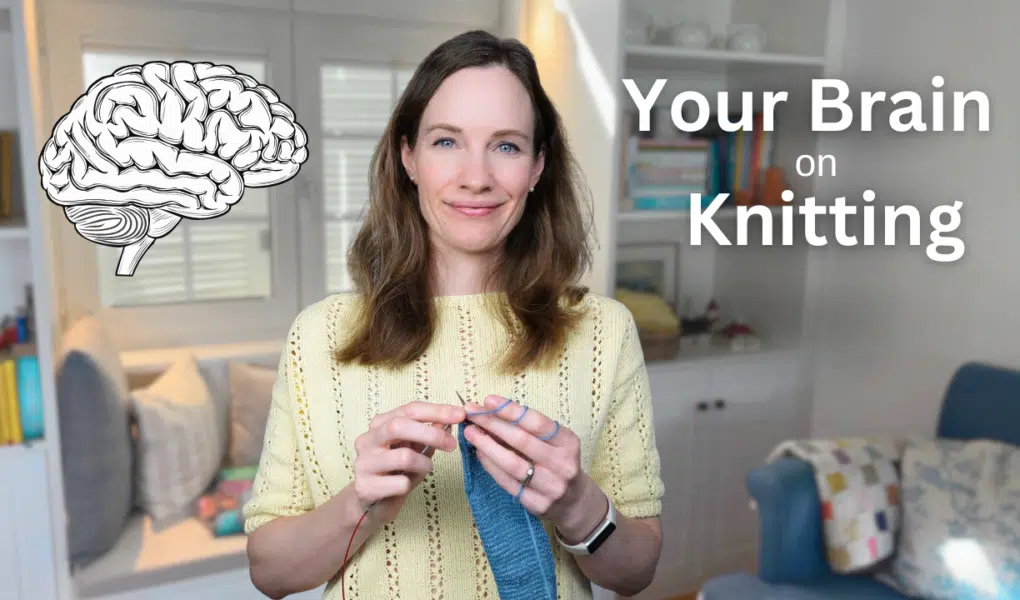
Modern life is extraordinarily good at keeping you brain stimulated, and extraordinarily bad at letting it settle. Knitting does something almost opposite. And there are reasons why it feels so different. So in this essay I want to have a closer look at what scientists found about knitting.
There’s something strange that happens when I knit. I can sit down with my mind racing. I’m thinking about an email I still need to answer, something one of my kids needs tomorrow or what I’m going to film next. Or that slightly awkward conversation I had three days ago that my brain has apparently decided we need to revisit for the seventeenth time.
And then I sit down with my knitting. I make one stitch after the other and somewhere along the way… things get quieter. If you’re a knitter, you probably know exactly what I mean.
But recently I started wondering: Why?
Because knitting looks incredibly simple from the outside, it’s just two needles and some yarn.
But when researchers started looking at knitting and other forms of making, they discovered that there may be much more going on than we realize.
And if you’d rather watch than read, I explore this idea in the video below.
Why Does Knitting Feel So Different?
Think about what your brain has already done today. Maybe you checked your phone before you even got out of bed, you read messages, opened an email, started doing something, then a notification appeared, you checked it. And before you’ve even finished your morning coffee, your attention has already moved between dozens of different things.
Then compare that with knitting and your world suddenly becomes very small.
There’s the yarn, the needles and the stitch in front of you. Maybe the next line of your pattern. Your fingers are moving rhythmically, your eyes are following what you’re doing and you’re feeling the texture of the yarn between your fingers. You’re creating something tangible and your attention finally has somewhere to go.
What’s so interesting is that knitters themselves report feeling a difference.
In 2013, researchers surveyed 3,545 knitters from around the world about why they knit and how it affected them. Relaxation, stress relief and creativity were among the reasons people commonly gave for knitting.
But the researchers also found a significant relationship between how frequently people knitted and how calm and happy they reported feeling. Frequent knitters also reported higher perceived cognitive functioning. And people who knitted in groups reported benefits around happiness, social contact and communication.
Now, there’s an important distinction I need to mention here: This doesn’t prove that knitting caused those differences. It was a survey of knitters, not an experiment where scientists randomly assigned one group to knit for six months and another group not to knit. But it does tell us something fascinating:
A lot of knitters seem to be experiencing the same thing.
That feeling we have when we say: “I just need to knit for a while.” may not be unusual at all.
When You Lose Track of Time
Have you ever sat down intending to knit for twenty minutes and suddenly an hour has disappeared? You’re not asleep , you didn’t zone out, in fact, you’re actually extremely focused. But the effort somehow doesn’t feel like effort.
Psychologists often describe experiences like this using the concept of flow: Becoming deeply absorbed in an activity that has a balance between challenge and skill.
And knitting is unusually good at creating the conditions for that. Think about a simple stockinette project, for example. It’s not so easy that you’re doing absolutely nothing. You still need to maintain your tension, notice where you are and move your hands. But once you’re experienced, you don’t have to consciously think:
insert right needle from front to back…
wrap yarn…
pull loop through…
for every single stitch.
There’s enough happening to hold your attention without necessarily overwhelming it. And this may help explain something we saw in that survey of 3,545 knitters. People weren’t only reporting that knitting made them feel relaxed. They were reporting calm and happiness. And those aren’t quite the same thing.
The Surprising Complexity Of Knitting
Because if knitting is relaxing because it’s simple: Why is learning to knit so difficult?
Think back to your first knitting lesson. Suddenly you have two sticks, there is yarn everywhere and someone is telling you to put one needle through a loop while holding the yarn at exactly the right tension. It feels impossible. And even when you’re experienced, knitting can become enormously complicated.
When we follow a knitting pattern, we may be: reading abbreviations, counting, interpreting symbols, remembering where we are, coordinating both hands, maintaining tension, feeling what’s happening through the fingers, spotting mistakes and imagining how a flat piece of fabric will eventually become a three-dimensional garment. All at the same time.
So knitting sits in this fascinating middle ground: It can be calming without being passive. And I think that’s a really important distinction. Because sometimes when we say we’re “relaxing,” what we’re actually doing is consuming more information.
Knitting simply asks something different of us, it asks us to participate.
What Happens When We Learn?
This also brings us to one of the most interesting things about the brain: It isn’t static. Our brains continue adapting as we learn and practice skills. That’s is called neuroplasticity.
But this is also where I want to be careful. You’ll sometimes hear very dramatic claims online that knitting has been proven to “rewire your brain.” But the reality is more nuanced.
Learning and repeatedly practicing complex skills involves neuroplasticity generally. But we don’t yet have strong knitting-specific brain-imaging evidence showing exactly how a knitter’s brain structurally changes after six months of knitting. And I actually think the research we do have is interesting enough without exaggerating it.
Because researchers have looked at something else: Whether people who engage in mentally stimulating activities appear to fare differently cognitively as they age.
Can Knitting Help Your Brain As You Age?
Researchers from the Mayo Clinic studied 1,321 people between the ages of 70 and 89. They asked about mentally stimulating activities including reading books, playing games, using computers and doing crafts such as knitting and quilting. And craft activities were associated with lower odds of mild cognitive impairment.
That sounds extraordinary, but there’s an important caveat. This was an observational study, so it cannot prove that knitting itself prevented cognitive impairment. It’s possible that people who remain cognitively healthy are more likely to continue doing activities such as knitting. There may also be differences in lifestyle, social engagement, education or health.
I would never tell you “knitting prevents dementia.”, because we don’t have evidence for that.
But researchers studying cognitive reserve are increasingly interested in the relationship between intellectually stimulating activities throughout life and cognitive health in older age. Mayo Clinic’s own overview describes evidence linking intellectually and socially active lives with lower risk of later cognitive impairment.
And knitting happens to combine several things at once: learning, problem solving, movement, attention, creativity, and often social connection. Which brings us to something I think might be even more important.
The Benefits Go Beyond The Brain
In 2024, researchers published a review looking at 25 studies of needlecraft, including knitting, crochet, sewing, embroidery, quilting and lacemaking.
And when they looked across all of that research, four themes kept appearing: Mental wellbeing, social connection, purpose and identity.
And I find those last two particularly interesting, because they’re things that are very difficult to see on a brain scan. When you’ve spent three months knitting a garment and finally put it on…you haven’t simply occupied your brain for three months. You’ve made something.
And perhaps that’s one reason knitting can become so important during periods when other parts of life feel uncertain. The world might feel messy, your life might feel messy. You might not know what happens next, but this stitch goes here and then you make the next one. And eventually those tiny actions become something.
So What Does Knitting Actually Do?
So after going through all of this research, I think my answer is slightly different from the one I expected.
Does knitting magically transform the brain? We don’t have evidence to say that.
Does it prevent dementia? Again, we can’t say that.
But research does suggest something much more interesting than the dramatic headlines: Knitting combines attention, skill, creativity and purposeful action.
Thousands of knitters report using it for relaxation and stress relief, and frequent knitting has been associated with feeling calmer and happier. Research across needlecraft repeatedly finds themes of wellbeing, connection, achievement, purpose and identity. And observational research has found associations between cognitively stimulating activities including crafts and better cognitive outcomes later in life.
Maybe the reason knitting feels so good isn’t one magical thing happening inside our brains. Maybe it’s the combination: Our hands are occupied, our attention has somewhere to settle. We’re learning, solving problems, creating. And at the end of all that effort… something exists that didn’t exist before.
And I think that’s why I’ve become even more grateful for knitting as I’ve gotten older. It isn’t just something I do when I have nothing else to do. It is something I deliberately make room for. Not because I think every minute of my life needs to be productive or optimized for brain health. Quite the opposite.
Sometimes I just want to sit down… pick up my knitting… and make one stitch. And then another. And let the rest of the world be noisy for a while.
Further Reading on What Scientists Found About Knitting:
The Benefits of Knitting for Personal and Social Wellbeing in Adulthood: Findings from an International Survey: https://journals.sagepub.com/doi/abs/10.4276/030802213×13603244419077
“I just love it”: Avid knitters describe health and well-being through occupation: https://pubmed.ncbi.nlm.nih.gov/30857405
Healing Stitches: A Scoping Review on the Impact of Needlecraft on Mental Health and Well-Being: https://pubmed.ncbi.nlm.nih.gov/39008815
The effects of crafts-based interventions on mental health and well-being: A systematic review: https://onlinelibrary.wiley.com/doi/full/10.1111/1440-1630.70001
Engaging in cognitive activities, aging, and mild cognitive impairment: A population-based study: https://mayoclinic.elsevierpure.com/en/publications/engaging-in-cognitive-activities-aging-and-mild-cognitive-impairm-2
Creating arts and crafting positively predicts subjective wellbeing: https://pubmed.ncbi.nlm.nih.gov/39220449
Brain-building: How to grow your cognitive reserve: https://mcpress.mayoclinic.org/healthy-brain/brain-building-how-to-grow-your-cognitive-reserve


